// 2026 · LIVE
Ci può essere amore senza logiche di dominio?
Domination precedes us, runs through us, leaves marks that can be counted. Yet when it comes to pointing at it, no one looks from the same place. Two performers embody it; the audience, voting in real time, believes it is measuring it — and is measuring itself.
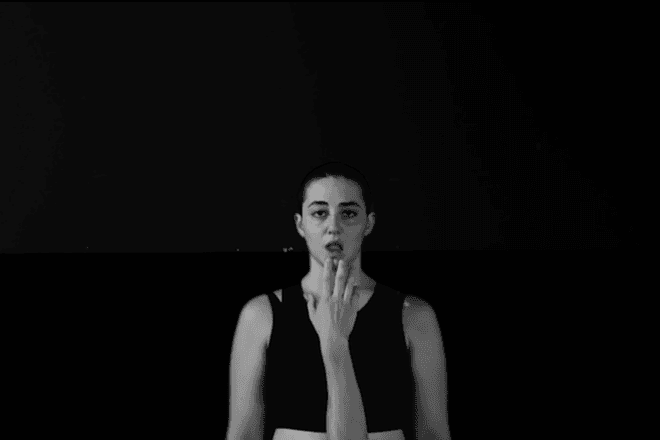
Romantic love grew up inside a grammar of power: who leads and who follows, who takes up space and who adapts to it. This work starts from a suspicion — that this grammar lies not only in the two bodies, but in the eye that reads them. That the balance of a relationship is also an optical effect, and domination a label we attach from the outside, almost never asking ourselves what guided our hand.
On stage, two performers, a man and a woman, hold a bond that slides between its possible distributions of power. The audience is asked to say, moment by moment, who dominates. But that judgement is never neutral: the culture we grew up in — and the patriarchal logics that run through it — decides in advance what we read as domination. Each answers for themselves, and finds themselves beside everyone else.
The choice of a man and a woman is deliberate: the very same action becomes strength on one body and arrogance on the other. Those who came to observe a dynamic of power then struggle to say on which side they saw it arise.
In most couples, dominance never announces itself. No orders are needed: it is enough that the need of one sets the climate of the house, and that the other organises itself around that need without noticing it any more. When one shuts down, the air grows denser and no one knows whose fault it is; when they return, the air turns breathable again. They hold each other up over an absence, and it suits them both not to look at it, and all of this goes by the name of love. It is a form of power so quiet that neither of them names it: neither of them truly occupies the centre, and neither of them knows how to leave any more.
What we call love
Love and domination do not cohabit. This is the premise the work starts from, and it did not invent it: bell hooks leaves no room when she writes that "Love cannot exist in any relationship that is based on domination and coercion." In The Will to Change she insists on a point this work takes seriously: patriarchal thinking is not the property of men, women too transmit it and act it out. In All About Love she separates love from cathexis — the investment through which a person becomes necessary to us, and which can hold perfectly well while we neglect or hurt them. The couple described above stands there: not in love, but in an economy of need that holds. For hooks love is an action and a practice, not a state one finds oneself in. The work does not deny that domination exists. It asks those who watch whether they can recognise it — and what, in their own gaze, decides where to recognise it.
An educated hope. José Esteban Muñoz, in Cruising Utopia, takes from Ernst Bloch the docta spes: an educated hope, opposed to the abstract hope of generic desire, because it knows the obstacles and takes them into account. His method is to look for utopia in the smallest everyday things — gestures that last a few seconds and leave no trace, and that for this very reason show that another way of being together is already practicable. This is the invitation this work takes up. For the length of a performance a room can practise looking differently: not asking the relationship to be resolved, but training a gaze able to recognise the moments when domination stops being the only language spoken at home. Where someone yields without losing, where no one keeps score, where intimacy does not pass through whoever commanded last. They are brief, and they happen. The work asks only that they be looked at long enough to be counted.